

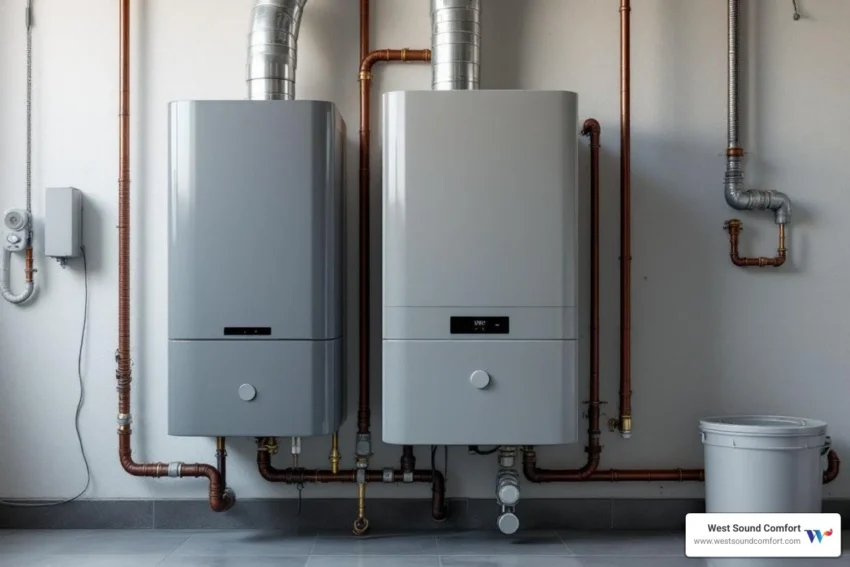
A boiler failure is not often predictable. It gradually happens, due to minor inefficiencies, some components that are not working at their best, or service appointments that have been postponed, up to the point when your business is forced to shut down.
As a facility manager or business owner, this issue goes beyond simple maintenance. It directly impacts your business continuity.
The boiler as a single point of failure
Many building owners rely on historical data and/or regulatory suggested recommendations as to when to replace parts. The problem with this approach is it is entirely based on reactive management.
Efficiency is money leaving through the flue
Here is a number to consider: scale or soot accumulation of only 1/32 of an inch on boiler heating areas can decrease boiler effectiveness by up to 10%. This loss in efficiency can be particularly costly if boiler operates year long. Defective boiler sealing areas can lead to higher energy expenses and costly repairs. For industrial facilities with boilers, energy expenses are not generally accounted for. Over time, components break down from use, and that includes your industrial boiler.
If your commercial boiler is not consistently being serviced, scale accumulates on the heating surface. If it is not scale, its soot. Reduced heating area results in the burner having to run longer be losing more heat to the heat stack. Soot build-up of as low as 1/8-inch in the furnace can decrease your boiler’s efficiency by consuming fuel up to 2.5 percent. Facilities in the ACT region should schedule their Boiler Preventative Maintenance Canberra ahead of the coldest months, particularly given the area’s water chemistry, which accelerates scale buildup without proper treatment protocols in place.
“Fouling of the heating areas by soot and scale decrease boiler effectiveness to the point where it becomes more affordable to replace the boiler than clean it.” – The National Institute of Standards and Technology. US Department of Commerce.
What modern diagnostics actually catch
The maintenance equipment accessible now is way more than visual inspections and stress testing. Thermal imagery locates hot spots that give away uneven heating or potential cracks in the heat exchanger. Ultrasonics find hairline fractures in pressure vessels when they’re still barely visible.
This is not exotic gear. This gear is part of the kit that marks you as running a professional maintenance shop rather than many contractors, and it does a whole lot more than just tick off a compliance report.
The temperature of flue gases on the stack, for example.
Testing flue gasses – just another regular service operation for a trained engineer, at a slightly greater length than a cursory look-see with a flashlight – tells you exactly the air-to-fuel ratio your burner is operating under. If it’s wrong, that’s not just an efficiency issue, although God knows how razor-thin your margins are that it pops the imprecise combustion right to mind.
We’re talking carbon monoxide pouring out of your stack there. In an enclosed plant room. In an industrial setting. That’s an OHS exposure record right there. A full-hour combustion tune-up, as many chimneys you have. Do you want to explain in court why you didn’t think it was worth having the work done? A garage or occasional freshly-painted wall is one thing, but that stack of yours is letting regular employees breathe poison.
Condensing boilers – boilers that lean on the rugged side of the cost-per-kilowatt scale, just because of the sheer expense that goes into engineering the heat out of your exhaust – need a clean heat exchanger. If that’s not maintained, you’re losing your money’s worth within a few years. A regular 500kW burner service can take 10 minutes to check for hairline cracks, or an hour to make sure nobody’s going to die.
The compliance and insurance argument
This aspect of the discussion is often not top of mind and doesn’t get the attention it deserves.
Various boiler insurance policies include clauses that restrict damages repayment unless evidence of professional maintenance is provided, meaning that a loss of six or seven figures may not be covered If that boiler was un-serviced for a period. Not only that isn’t operationally protected – it’s unlikely to be legally protected. Can you hand over the full history of scheduled inspections and mandatory tests and provide physical access to the inspector? If not, you’re operating at unnecessary risk.
When a legal or compliance body demands maintenance records, the wrong answer isn’t that you don’t have them – it’s that you don’t have them to provide upon request. Insurers will assume the latter if you’ve not been able to provide a log within the past two-years.
Managing the asset, not just the equipment
A boiler is not a factory but a capital asset, and its functional life is directly determined by its management. Preventive maintenance can increase its service life by several years, properly model and forecast your major capital budget and maintain performance predictability.
Why be proactive about managing your boiler assets? For starters, scheduled service costs are fixed and known. Emergency repairs, insurance claims, penalties due to non-compliance and operational downtime are not. It’s your money or theirs.