

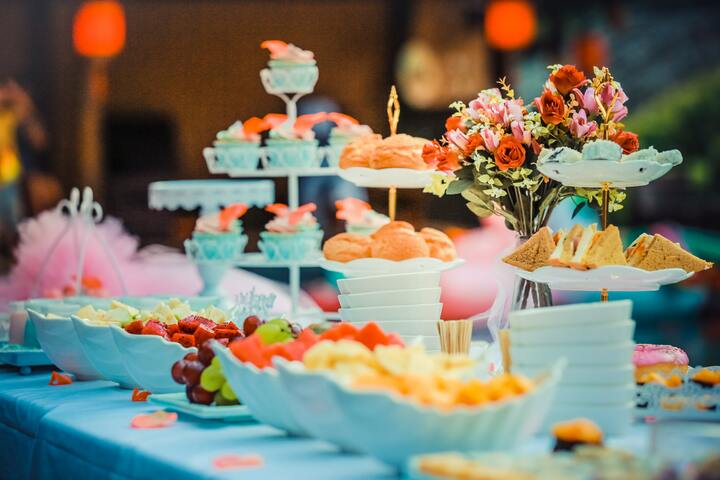
A graduation dessert table serves a bigger purpose than just holding sugary treats, it’s a decorative statement that invites guests to enjoy the festivities. If you get the setup perfect, your guests will be Instagramming the table as they get their first taste. If it’s not well executed, it just looks like a PTA snack stand.
Start With a Color Story, Not a Shopping List
Before you order a single treat, consider your color scheme. The graduate’s school colors are a jumping off point, but the mistake most folks make is throwing those colors all over and at full strength. That’s how you turn a table into a clown car.
Instead, think in terms of three players: a main color, a supporting color, and a neutral base. Example, say the school colors are navy + gold. Navy is your main player, in linens, background, and main cake. Gold is the supporting role and comes out in things like topper motifs, candle sticks, ribbon. White or cream is the neutral base and is in there to soften the entire spread so there’s a place for your eye to rest.
Limiting it to three colors isn’t about being stingy. It’s about keeping the table from giving itself a seizure.
Apply it consistently across the board, don’t just think food. Think tablecloth, think about the backdrop behind the table, think about labels on each dessert. A gold star on a white label card reads as intentional. A random mishmash of pink, yellow, and green labels reads as an oh-I-forgot.
Build the Table From a Focal Point Outward
Every professionally styled dessert table has one thing working in its favor: a single piece that draws the eye before anything else. That’s your focal point, and it almost always belongs at the center of the table at the highest elevation.
This is where the main cake lives. Professionally designed graduation cakes are built for this role, they carry the detail, the height, and the visual weight that smaller items simply can’t. Once your centerpiece is in place, everything else on the table is styled around it.
From the center, work outward symmetrically. If you have two tiers of cupcakes on the left side, match them with something of similar height on the right, even if it’s a different item entirely. The goal is balance, not matching sets. Visual weight matters more than identical products. A tall glass jar of cake pops on the right can balance a tiered cupcake stand on the left as long as their heights are close.
Keep smaller, flatter items toward the outer edges and the front of the table. Stacked macarons, mini tarts in a low ceramic dish, brownie bites in a clear display box, these frame the table without blocking the view of the centerpiece behind them.
Use Height to do the Work That Decoration Can’t
A flat dessert table will always look amateur, no matter how beautiful the individual items are. The trick is variation in height, and you don’t need expensive equipment to achieve it.
Acrylic risers give a modern look and work great if the palette is neutral or monochrome. Wooden crates stacked at angles read as rustic and warm. Tiered metal stands carry a lot of visual weight and work just fine for cupcakes or petit fours. Even wrapped boxes under a tablecloth will prop items up as needed for no additional expenditure.
The idea here is that the guests should see the table in layers as they approach. The tall items are at the back and register first, the mid-height pieces fill the middle ground, and the low items at the front are what they actually reach for. If everything sits at the same level, that layered reveal you’re looking for disappears and the table looks flat from across the room.
A really easy place to start is planning for at least three distinct height levels across the table. Tall (the centerpiece cake and any stand that reaches above 12 inches), medium (6-10 inch risers with cupcake towers or cake pops), and low (flat platters, boards, or small display dishes sitting directly on the cloth). You don’t need more than three – you just can’t get away with fewer.
Calculate Quantities Before You Order Anything
Estimating quantities is how hosts get stuck with either too little or two boxes of unwanted leftover desserts.
The pro catering guideline: if it’s a main cutting cake plus a variety of bite-sized, allow 3 to 4 mini per guest. If it’s all minis with no cutting cake, plan 6 to 8 per guest (from pro catering and event planning guidelines). So 40 guests with a main cake means 120 to 160 minis on top of the cake itself.
Divide those pieces between 4 to 6 different varieties. One flavor-dominant option, like chocolate brownies or salted caramel tarts. One or two light, acidic options, like lemon bars or raspberry macarons. One visually striking one that also doubles as decor; ex. pops in school colors. And at least one that fits any guests with dietary restrictions.
Don’t just look for variety though, consider texture as well. All soft, all creamy gets oppressively heavy and monotonous by the third piece. Mixing crispy macarons with fudgy brownies and a light panna cotta guarantees they get a different experience with every bite, which keeps people coming back.
Plan For Heat Before it Becomes a Problem
Graduation parties and outdoor venues, being so common in summer, pose a confectionary conundrum for anything buttercream, whipped cream, or dairy-based filling. Buttercream softens and mutes in anything above 75°F. One pretty rosette border on a cake and that can degrade into a cake plate full of mess in an hour outside.
Fondant should be the go-to for the main cake if the party is entirely outside or in a non-air-conditioned venue. It holds its shape in heat and keeps its finish longer than buttercream. Save buttercream for items that guests will consume quickly, like cupcakes that get picked up in the first 30 minutes.
For dairy-heavy items such as panna cotta, mousse cups, and creamed pastries, keep them off the table until guests arrive, and place the serving dishes inside shallow trays filled with ice to keep their temperature stable during the event. A shaded canopy or umbrella positioned directly over the table can cool things a good 10 degrees or more even in midday sun.
Also, consider time of setup. Macaron towers, cake pops, and fondant-covered items are okay to set out 2 hours prior. Anything with cream or fresh fruit goes out 30 minutes before, maximum.
Set up an Allergen-Friendly Section With Intention
Nowadays, dietary restrictions are so common that they can come across as rude to ignore. But the way most hosts go about addressing them, one gluten-free cupcake crammed onto the dessert table, doesn’t do any good because it doesn’t actually address the main problem: cross-contamination. As soon as your gluten-free cupcake gets cut with the same knife the hosts used to cut the regular ones, “safe” goes out the window.
Physical proximity is just as dicey. Even if you carefully label a dish as nut-free, that’s not a lot of help if it’s literally touching a walnut. Here’s what you can do instead to properly address this:
Designate one section of the table (hopefully, one end of the table) specifically for allergen-friendly items. Use individual dome covers or small cloche covers over these dishes to keep airborne nut-dusted or flour-dusted items out. Put out separate serving utensils that are visually distinct – different color handle, a ribbon tied around the spoon, etc., so your guest doesn’t accidentally use the shared one.
Custom signage for the win. A small printed card that reads “gluten-free” or “nut-free” in large, clear text takes the guessing out for your guests and saves you the trouble of answering questions all evening long. Make sure they match the design of the rest of the table so this section doesn’t look like a medical precaution. It should look like a considered part of the overall design.
Run a 72-Hour Countdown Instead of Winging it
The most significant execution failures at dessert tables are the result of leaving too much for the day of the event. Here’s a realistic prep timeline that eliminates last-minute chaos.
Three days out: Finalize orders with your bakery, if you haven’t already. Purchase all non-perishable supplies, linens, risers, signage materials, candles, serving utensils. Bake anything you’re making yourself that holds well, like shortbread or biscotti.
One day out: Pick up any custom orders that are ready. Iron linens, assemble risers and stands, and do a dry run of the table layout without food to confirm the spacing and height structure works. Prep any fresh items you’re making yourself, refrigerate immediately.
Morning of the event: Set the table fully with linens, backdrop, signage, and all display equipment. Set out non-perishables two hours before guests arrive. Cake comes out of the box and onto the table 45 to 60 minutes before the start time. Cold or cream-based items come out 20 to 30 minutes before.
Have one person designated to check on the table every 30 minutes during the event, to refill platters, remove anything that looks tired, and keep the layout looking intentional as items get picked up.
A graduation party dessert table that looks professionally styled isn’t the result of a bigger budget. It’s the result of a clear plan, knowing what goes where, why the heights work, what the color story is doing, and what happens when the temperature climbs an hour into the party. Build the structure first, then fill it in. Everything else follows from that.